
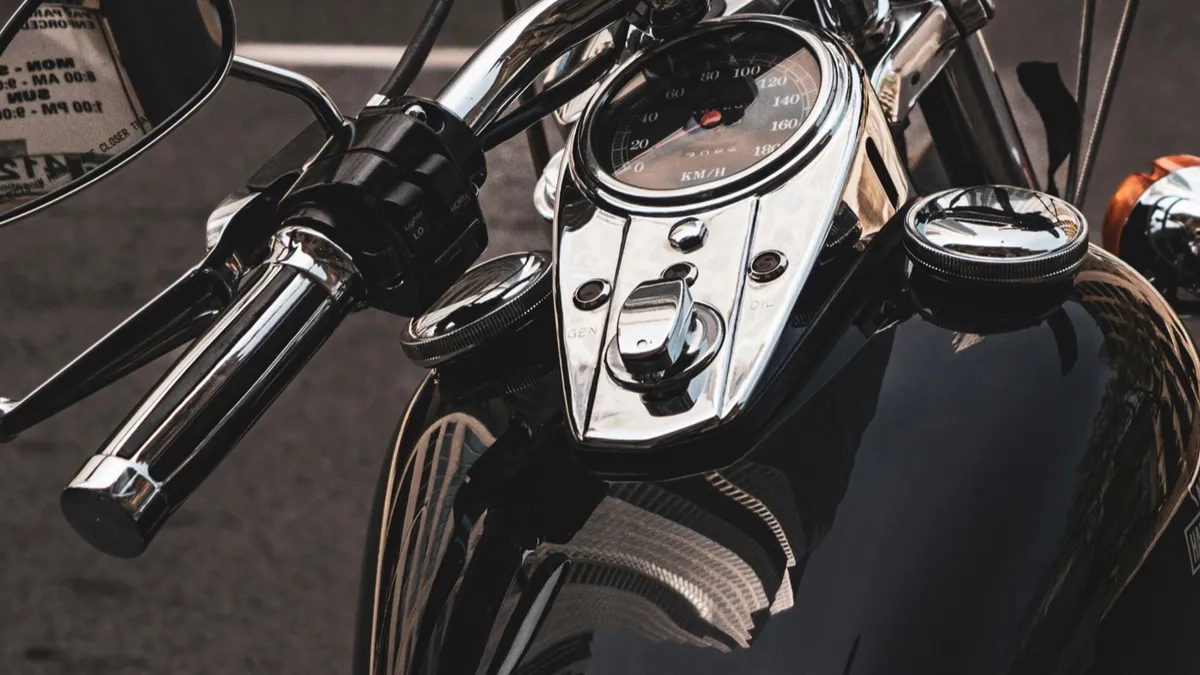
Importers order CNC motorcycle levers by photo — anodized color, machined lines, a good price — and the returns start three months later when levers fade under tropical sun, snap at the pivot after a tip-over, or simply do not bolt onto the bikes their customers ride. The listing photo was never the product. This guide replaces the photo with the four specifications that actually decide whether a lever line sells or comes back.
We build and ship brake, clutch and shift levers to Latin American distributors, and this guide comes from that floor, not from brochures: the alloy data behind 6061 and 7075 billets, what Type II and Type III anodizing really cost and deliver, which adjustment features riders pay for, and the fitment checklist that keeps a container out of the returns pile.
6061 vs 7075 billet: the alloy decision
Nearly every quality CNC lever starts as one of two alloys. The published mechanical values make the trade-off concrete:
| Property | 6061-T651 | 7075-T651 | What it means for a lever |
|---|---|---|---|
| Tensile strength | 45,000 psi (~310 MPa) | 83,000 psi (~572 MPa) | 7075 resists bending under crash and stunt loads |
| Yield strength | 40,000 psi (~276 MPa) | 74,000 psi (~510 MPa) | The elastic limit — where a bent lever stops springing back |
| Brinell hardness | 95 | 150 | 7075 survives pivot and perch contact wear longer |
| Elongation at break | 12% | 10% | Both tolerate impact without snapping like cast zinc |
Values from Clinton Aluminum’s published alloy datasheets. In our production split, 6061-T6 is the workhorse for adjustable and foldable street levers: it machines fast, anodizes evenly, and hits the price point a Latin American parts shop can stock at two or three colorways. 7075 earns its premium on stunt, supermoto and off-road levers, where repeated tip-overs and one-finger loads punish a softer billet. A supplier who cannot tell you which alloy a given lever uses is telling you something important.
Billet machining also buys consistency a casting cannot: industry comparisons put CNC machining tolerance around 0.01 mm, with uniform grain structure and no cast-in porosity, and a typical weight saving of only 10–20 g per lever over cast equivalents — a real but minor gain riders notice less than the feel.
Type II vs Type III anodizing: the finish that survives the sun
Color is what sells the lever at the counter; anodizing is what keeps it selling after a wet season. Both common processes are sulfuric-acid anodizing under MIL-PRF-8625, but they are different products:
| Type II (sulfuric, decorative) | Type III (hardcoat) | |
|---|---|---|
| Coating thickness | 0.0002″–0.0008″ (≈5–20 µm) | nominal ~0.002″ (≈50 µm) |
| Surface hardness | Conventional anodize | 400–530 HV — roughly 10× more wear-resistant in Taber abrasion testing |
| Color | Takes dye uniformly — black, blue, red, gold | Inherently dark gray to bronze; dye options limited |
| Cost | Lower | Higher |
| Watch-out | Thin dyed layer can wear at the contact patch | Published fatigue debits of 30–50% on some high-strength alloys — the thick brittle oxide can initiate cracks under cyclic load |
Process data from Gleco Plating. For Latin American street stock, dyed Type II in five or six colors is the right default: it keeps the color range wide and the unit cost where a distributor needs it. Specify the dye class on the purchase order — a cheap dyed finish fades to pink within one Brazilian summer of UV and rain, and that is the “quality problem” we most often see blamed on the whole category. Hardcoat belongs on levers that live behind handguards on trail and enduro bikes, where abrasion — boots, branches, crashes — outranks sunshine.
From our pre-shipment checks: the two lever failures we catch most are pivot bores machined 0.1–0.2 mm undersize, which bind the lever on the OEM perch bolt, and anodizing that was never sealed — it wipes silver-gray with solvent on a white cloth. Both are 100% factory-detectable with a go/no-go pin gauge and a solvent wipe; both reach your warehouse only if nobody checked.
Adjustable reach: the feature riders feel on day one
A fixed lever fits one hand size. An adjustable one fits the commuter in sandals on a CG 160 and the tourer in winter gloves on a Versys — the reason adjustable span is the single most-requested upgrade across every segment, and the reason Brazilian accessory blogs list regulagem de distância before color when they compare sport levers to stock.
| Adjustment type | What it changes | Who buys it |
|---|---|---|
| Fixed OEM-style | Nothing | Replacement demand only; cheapest line |
| Dial-adjustable (typically 6 positions) | Lever-to-grip distance in indexed steps | Street and commuter upgrades; the volume seller |
| Tool-free fine adjuster wheel | Continuous reach, settable with two fingers on the bar | Premium and touring lines |
When you evaluate the dial, count the detents and test them at the bench: a quality 6-position mechanism clicks positively and holds under a hard pull; a weak one drifts to the closest setting within a week, and the customer reads “adjustable” as “broken.”
Foldable, short and long: matching the lever to the rider
Folding levers — manetas abatibles, as the Spanish specialist press calls them — pivot outward on impact instead of bending or snapping, and they reposition by hand after a tip-over, which is exactly why Motociclismo recommends them as cheap insurance against larger damage in everyday falls. The feature splits the market cleanly:
| Lever format | Behavior in a fall | Best-selling segment |
|---|---|---|
| Fixed standard length | Bends or breaks at the pivot; often strands the rider | Budget replacement, fleet use |
| Foldable (articulated) | Pivots away, repositions by hand | Off-road, delivery, urban commuters who drop bikes at standstill |
| Short (2-finger) | Same strength, less finger sweep | Sport riders who keep one or two fingers covering the lever |
| Long (standard) | Maximum leverage for a full four-finger pull | Touring, cruisers, riders with large hands or heavy gloves |
Long-versus-short is a preference, foldable-versus-fixed is an environment: stock foldables where the bike goes down regularly — delivery fleets, learner bikes, trail and enduro — and keep fixed levers for price-led replacement volume.
The foldable and short designs below cover the urban commuter through the stunt scene, in both dial-adjustable and one-finger formats:
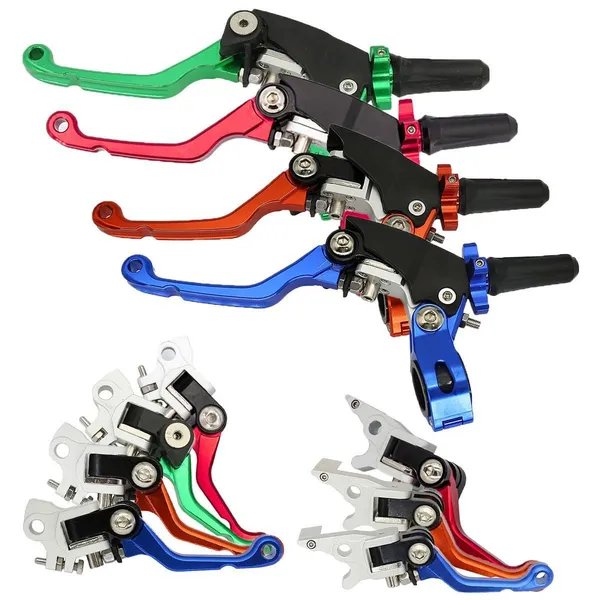
- Material:
- CNC-machined aluminum alloy, anodized
- Mounting:
- Direct perch/bracket mount, no adapter required
- Type:
- CNC clutch and brake levers, foldable
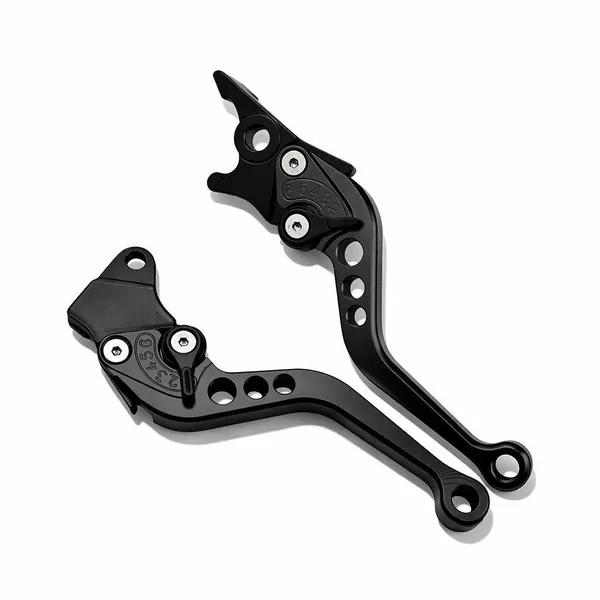
- Material:
- CNC-machined aluminum alloy, anodized finish
- Type:
- Brake / clutch lever, cable-actuated
- Adjustment:
- Indexed reach-adjuster dial (numbered positions)
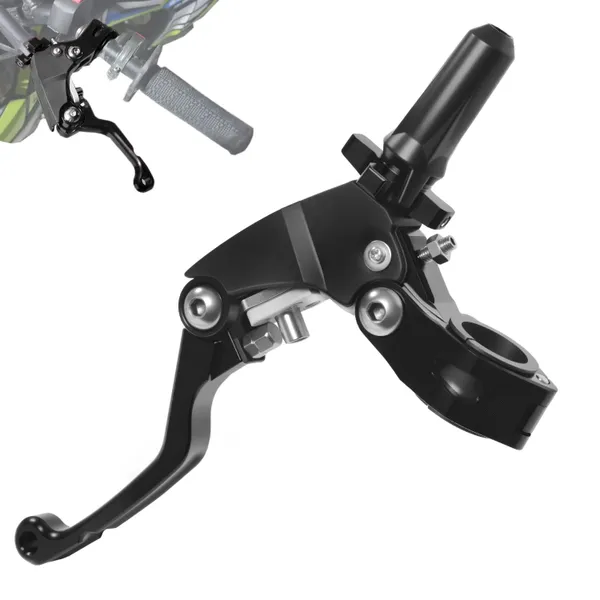
- Material:
- Aluminium alloy
- Mounting:
- Handlebar clamp with cable adjuster, front position
- Type:
- Foldable clutch lever (3-finger / stunt)
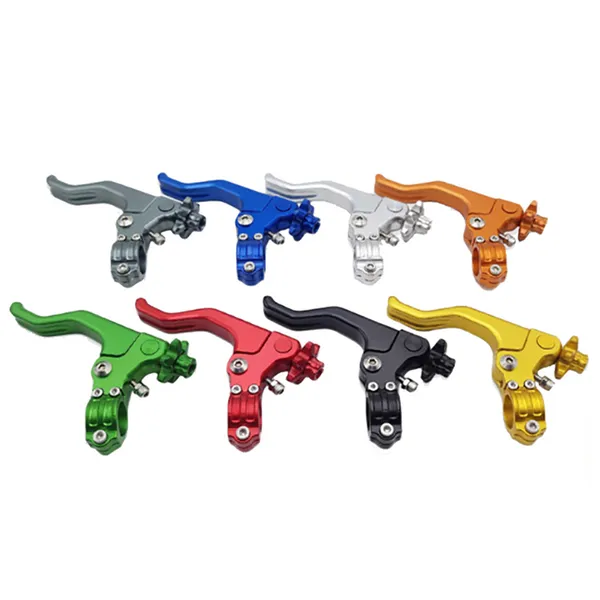
- Material:
- CNC aluminum alloy
- Handlebar Fitment:
- 22 mm (7/8 in) handlebar
- Product Name:
- 22mm short stunt clutch lever (one finger)
For the growing stunt niche in Brazil and Mexico — where riders run one finger on the clutch for hours — an easy-pull system that reduces cable effort belongs in the same conversation as the lever itself; the stunt clutch levers in our catalogue cover both directions.
Fitment: the checklist that prevents returns
Compatibility is the most common sourcing mistake in the category, and the most expensive one: a lever set that does not bolt on is a full container of dead stock. Left and right are not interchangeable, cable and hydraulic pulls use different actuator geometry, and pivot spacing differs between models that share an engine.
| Check | Why it matters | What to send the factory |
|---|---|---|
| Make, model, year | Pivot spacing and perch shape change across generations | A fitment list by model year, not just model name |
| Brake vs clutch side | Right (brake) and left (clutch) have different pivots and actuators | Order both sides explicitly; never assume pairs |
| Cable vs hydraulic | Different pin length and pivot geometry | Photos of the stock lever from both sides |
| Perch / master cylinder origin | Aftermarket perch kits need universal or matched levers | Whether you sell lever-only or lever-with-perch |
| Bar diameter context | 22 mm vs 28.6 mm bars signal bike class and buyer type | Your top five models per market |
Send the factory the stock lever photos, not just model names. A photo settles cable-versus-hydraulic and pin-length questions that a model list leaves open, and it is the difference between a clean first order and a 20% return rate.
What to stock for Latin America
The demand base is enormous and still growing: Abraciclo puts Brazil’s motorcycle fleet at 38.3 million units by the first half of 2026, up 46.8% from 26.1 million in 2017, and INEGI counts 10,547,500 registered motorcycles in Mexico after 17.8% fleet growth in 2025. Nearly every one of those bikes has two levers wearing out in sun and rain.
| Buyer profile | Recommended first order | Notes |
|---|---|---|
| Parts shops / e-commerce sellers | Dial-adjustable 6061 sets in 4–6 colors, top-20 local models | Color breadth beats exotic features at retail |
| Delivery fleets and motofrete | Foldable long levers, plus spare pivot hardware | Downtime cost dominates; foldables cut replacements |
| Off-road and trail shops | Foldable short levers, 7075 option, hardcoat finish | Abrasion resistance matters more than color range |
| Custom / stunt builders | Short and 3-finger levers, easy-pull systems, rainbow finishes | Small volumes, highest margins, fastest trend cycles |
Match the mix to the market: Brazil and Mexico reward broad colorways and fitment depth for high-volume commuter models, while the Andean countries — Colombia, Peru, Chile — over-index on trail and enduro formats where folding 7075 levers earn their price. If you are building the import side first, our guide on how to import motorcycle parts from China to Mexico walks through the logistics that apply to levers just as much as to lighting.
Frequently asked questions
Are CNC levers stronger than stock cast levers?
In bending and fatigue, yes — billet 6061 or 7075 has uniform grain and no cast porosity, and published alloy data puts 6061-T6 yield at 276 MPa against the low strength of zinc-aluminum castings. But a cheap lever with a soft pivot pin or thin adjuster mechanism fails exactly like a cheap casting, so judge the whole assembly, not just the blade.
Is 7075 always better than 6061 for levers?
Only where the load justifies it. 7075 nearly doubles yield strength but costs more per blank, machines slower and anodizes less evenly. For street adjustable levers, 6061-T6 is the correct alloy; reserve 7075 for stunt, supermoto and off-road lines.
Do foldable levers feel loose compared to fixed ones?
A well-machined folding joint has a fraction of a millimeter of play and riders stop noticing it within a day; a poorly machined one rattles and drifts. Ask the factory for the joint clearance spec and check it on the sample — this is one number that separates a premium foldable from a toy.
What is the difference between Type II and Type III anodizing for colored levers?
Type II is the thinner dyed finish behind almost all colored levers — wide color range, lower cost, adequate for street use if properly sealed. Type III hardcoat is ~50 µm thick, far harder (400–530 HV) and far more wear-resistant, but limited to dark tones; choose it for off-road levers behind handguards.
Can I mix colors, models and lever types in one wholesale order?
Yes — mixed-color, mixed-model orders are standard for lever lines, and factories serving Latin America typically price by total quantity across the mix rather than per SKU. The practical floor is a minimum per finish color, because anodizing runs are batched by color. Send your model list and target mix, and build the order around your top-fitment list.
How do I verify fitment without visiting the factory?
Stock-lever photos from both sides settle cable versus hydraulic and pin geometry; go/no-go pin gauges at incoming inspection catch bore errors in minutes; and a five-bike sample install — your five highest-volume models — before the container ships finds the rest. Our H4 LED headlight bulb installation guide shows the same sample-first discipline applied to another high-return category.
Source your lever line from one factory
A lever line earns its margin on fitment accuracy, finish durability and color breadth — all three are factory disciplines, and all three are easier to hold when brake, clutch and shift levers come from one production line. Browse the ranges — brake levers, clutch levers and gear shift levers — or review ready-to-order designs like the 6-position adjustable lever set, the telescopic folding levers and the rainbow long/short lever set. Send your top models per market and we will come back with a fitment-matched quotation: contact our team.