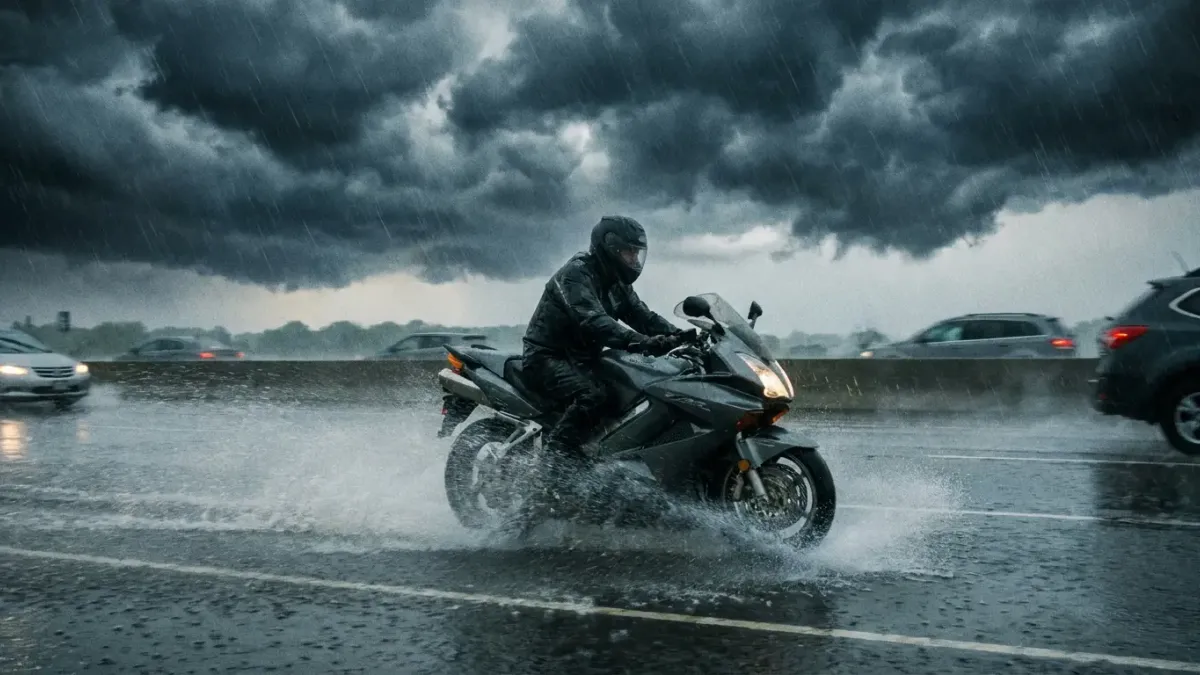
Buyers still treat a motorcycle cover and rain gear as the same product with a different label. They are not. One goes over a parked bike and protects paintwork, electronics and chrome; the other goes over a rider and protects a human being at 80 km/h in traffic. They sit in different categories, sell on different keywords, come from different factories — and mixing them up in a catalogue costs you conversion and returns.
We manufacture and export both product families, so this guide is built from purchase orders rather than brochures: what to write on a PO, which fabric numbers actually mean something, and where the cheap specification fails after four months of outdoor use.
The difference in one table
| Motorcycle cover | Rain gear (rain suit) | |
|---|---|---|
| Protects | The parked bike: rain, UV, dust, bird droppings, scratches | The rider: rain, wind and road spray while riding |
| Used | Stationary, outdoors or in a garage | Worn, often over riding clothes or armour |
| Sized by | Motorcycle length × width × height | Rider height, chest and inseam (M–4XL) |
| Buyer keywords | funda para moto, capa de moto, motorcycle cover waterproof | traje impermeable, capa de chuva moto, motorcycle rain suit |
| Spec that decides quality | Fabric denier + PU coating in mm + taped seams | Waterproof rating in mm + seam sealing + ride-position cut |
| Repeat purchase | High — covers degrade outdoors in 2–3 seasons | Medium — depends on use frequency |
| Returns risk | Fitment (too short, wrong handlebar width) | Sizing and breathability |
If your customers are riders, they want rain gear. If they are owners who park outside, they want covers. Most importers serving Latin America need both — as separate categories, and separately merchandised.
Motorcycle covers: the fabric ladder you should be buying from
“Waterproof Oxford” on a supplier’s listing means nothing until you see denier, coating and seam construction together. These are the tiers as they exist on the factory floor:
| Fabric | Weight | PU coating (hydrostatic head) | Where it works | Typical factory cost vs baseline |
|---|---|---|---|---|
| 210D Oxford | ~70 gsm | 600 mm | Indoor storage, dust and sun protection | Baseline |
| 300D Oxford | ~105 gsm | 1,500 mm | Outdoor in a moderate climate | +$0.60–0.90 / unit |
| 420D ripstop | ~140 gsm | 2,000 mm | All-season outdoor, windy sites | +$1.20–1.80 / unit |
| 600D Oxford | ~180 gsm | 3,000 mm + taped seams | Year-round outdoor, coastal and heavy rain | +$1.80–2.50 / unit |
For reference on the rain-protection scale: 1,000 mm shrugs off light rain, 3,000 mm handles sustained storms, and 5,000 mm+ is winter and coastal territory. A listing that says “waterproof” with no number is splash-resistant at best — and that is exactly the claim that comes back as a warranty claim six months later.
Also specify, explicitly:
- Sealed or taped seams — the coating only protects the panel; the stitch line is where water enters.
- Fleece or soft lining at the paint contact points, or a bonded inner layer.
- Wind straps and elastic hems — a cover that inflates in the wind abrades the tank.
- Lock holes (front and rear) and a storage bag. Small features, high perceived value.
- Vents at handlebar height; a fully sealed cover traps condensation under a hot engine.
- Heat-resistant panel where the cover touches a hot exhaust.
Sizing is where your returns come from
Covers are sold by dimension, not by model number. Ask customers (or your own catalogue team) to measure three things on the bike:
- Length — front tip of the front fender to the rear tip of the tail, in a straight line.
- Height — ground to the highest point, usually the windscreen or mirrors.
- Handlebar width — bar end to bar end; cruisers frequently exceed the front fender width.
Size up when in doubt. And when you write the PO, ask the factory for its fit tolerance — a serious cover factory measures to roughly ±2 cm on length and ±1.5 cm on width per size tier. If a supplier cannot quote a tolerance, they are grading by eye.
Rain gear: what actually keeps a rider dry
Rain gear fails in three predictable places: the seams, the cuffs and the crotch of a two-piece suit on a seated rider. Specification:
| Feature | Minimum for commuters | Recommended for highway / delivery riders |
|---|---|---|
| Waterproofing | 3,000–5,000 mm | 10,000–15,000 mm (sustained rain at speed) |
| Seams | Critically taped | Fully taped or welded |
| Fabric | 75D–100D polyester or Pongee with PVC/PU coating | Coated polyester with mesh liner for breathability |
| Zips | Storm flap | Waterproof zip + storm flap |
| Visibility | Reflective piping | 360° reflective strips at shoulders, back and calves |
| Cut | Over normal clothes | Ride-position cut: longer arms, raised knee, boot coverage |
| Construction | One-piece (no waist gap) | One-piece for heavy rain, two-piece for flexibility |
Two pieces of sourcing intelligence worth acting on: one-piece suits eliminate the waist gap where two-piece suits leak, but two-piece sells better where riders wear the jacket alone in light rain. And sizing runs M–4XL in the Latin American market, with MOQs around 200 sets per colour for a coated Pongee/PVC suit — plan the colour split before you ask for a quote, because a mixed-colour PO is where lead times slip.
Why the distinction matters commercially
- Different search intent. A cover shopper types “capa de chuva” in Portuguese and “funda para moto” in Spanish — the same shopper may want both products on different days. Separate landing pages, separate keywords.
- Different size logic. Covers are sized by bike, rain gear by rider. One catalogue page for both guarantees support tickets.
- Different supply chains. Covers come from textile and cover specialists; coated rainwear comes from garment factories with seam-sealing lines. One supplier for both usually means one of the two is a resale item.
- Different return profile. Cover returns are fitment complaints; rain gear returns are sizing and breathability complaints. Both are reduced by better specification sheets on your product pages, not by lower prices.
The QC traps we see on incoming inspection
These are real failure modes from the cover line, and each one is invisible on a product photo:
- Seam allowance shortfall. A cutter set to 8 mm instead of 12 mm sews and packs perfectly, then splits at the seams outdoors after about four months — exactly when you have sold out of returns stock and the warranty claims arrive.
- PU delamination around mirror pockets — the cheapest coating that “technically” meets the PO.
- Nylon thread instead of bonded polyester. Nylon absorbs water, swells and degrades under UV; bonded polyester is the correct thread for outdoor covers.
- Single-stitched stress points. Bar-tack or double-stitch every strap anchor and the hem.
- Bias cut versus straight cut. Bias-cut panels drape and stretch better but waste roughly 15% more fabric — decide which you are paying for.
We inspect 100% of covers before shipment for exactly these points, and we will send the inspection report with the goods.
Stocking plan for Latin American importers
| Buyer profile | Cover mix | Rain gear mix |
|---|---|---|
| General accessory distributor | 60% 210D–300D, 40% 420D–600D | 80% two-piece suits, 20% one-piece |
| Delivery-rider focused (apps, couriers) | 30% covers | 70% rain gear, focus 10,000 mm+ and high-visibility colours |
| Store-front retailer, coastal city | 40% 600D covers | 40% rain gear, plus ponchos for price entry |
Keep covers and rainwear in separate categories in your store — in Spanish, fundas/capas para moto versus trajes impermeables / capas de chuva — and link each to the specification table that answers the buyer’s actual question.
Frequently asked questions
Is a motorcycle cover waterproof enough to leave the bike outside all winter?
Only a 420D–600D Oxford cover with a 2,000–3,000 mm PU coating and taped seams should be sold for year-round outdoor storage. A 210D cover with a 600 mm coating handles dust and light sun, not months of rain.
Can the same fabric protect both the bike and the rider?
No. A cover fabric is built for stationary mechanical protection; rainwear needs a membrane or coated knit with sealed seams, ride-position cut and reflective visibility. They are different technical products.
What waterproof rating should I look for in a rain suit for highway riders?
15,000 mm with fully taped seams is the level that stays dry in sustained rain at highway speed; below 5,000 mm it is a light-shower product and should be described that way in your catalogue.
What MOQ should I expect for private-label covers and rain suits?
Covers are pattern-based, so tiered sizes can share a production run; coated rain suits are typically around 200 sets per colour and size curve. Both support private-label branding and custom packaging.
Source both product families from one factory
MaxorPro supplies motorcycle covers, rain gear and riding accessories to importers and distributors across Latin America, with private-label branding and inspection reports on every order. See the protection products range, including motorcycle covers, or request a quote with your size curve and target price point.